Why Faster Pages Still Need Better Flow
Page speed helps, but conversion comes from flow. See how structure, intent match, and UX clarity improve results.
Date published
Last updated
Fast pages are important. But speed alone does not create conversions, trust, or qualified leads. Many teams improve Core Web Vitals and still see weak business movement because users are entering faster, then getting lost in the journey.
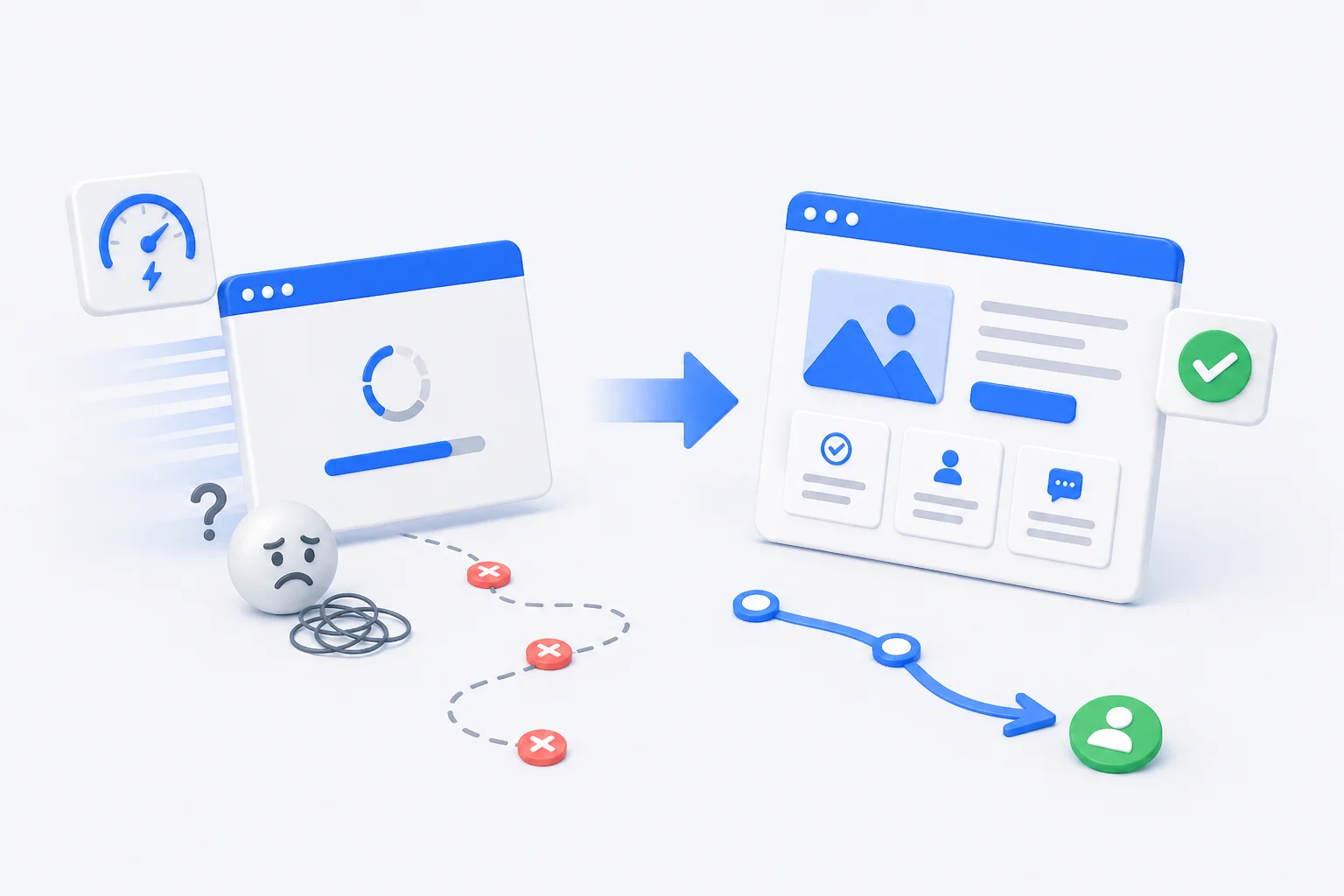
This is the missing distinction: performance gets users into the page. Flow helps them move through decisions. If flow is unclear, the benefit of speed fades quickly.
If your site is already “fast enough” but outcomes are flat, this is usually a flow problem, not an infrastructure problem.
What speed solves, and what it does not
- Speed solves first-impression friction, responsiveness delays, and technical frustration.
- Speed does not solve unclear value proposition, weak trust placement, or confusing next steps.
- Speed reduces wait time; flow reduces hesitation.
Web Vitals are still essential health signals. Google’s Core Web Vitals guide is a useful benchmark for measuring load, responsiveness, and stability. But those metrics should be paired with journey metrics, not treated as the finish line.
Why fast pages still lose users
- Message jump: headline promise does not match the next section’s focus.
- Trust lag: users see claims first and proof too late.
- Action ambiguity: CTA appears before users understand what happens next.
- Flow breaks between pages: users must re-interpret context at each step.
A practical speed + flow framework
1) Keep speed as baseline quality
Treat performance as non-negotiable. Slow pages destroy trust early. But once baseline speed is healthy, direct your next optimization sprint to decision flow.
2) Map friction by journey stage
Review where users stall: first-screen understanding, trust evaluation, CTA readiness, or form completion. NN/g’s user journeys vs user flows reference is helpful for separating broad journey issues from page-level flow issues.
3) Reorder for confidence, not aesthetics
Prioritise sequence: fit clarity, proof, process transparency, then CTA. This creates smoother decision momentum than visual polish alone.
4) Measure conversion quality, not only speed scores
Track qualified leads, sales-accepted enquiries, and stage-to-stage drop-off. This reveals whether flow changes are improving real business outcomes.
What to audit this month
- Your top three landing pages: does each have one clear decision job?
- Proof placement: does trust appear before commitment asks?
- CTA language and placement: does it match user readiness?
- Between-page continuity: are users forced to re-orient at every click?
Final takeaway
Speed is foundational, but flow is decisive. Teams that optimize both together convert better than teams that optimize either one in isolation.
For implementation continuity, pair this with UI vs UX and why mobile UX still decides conversions to align technical performance with decision design.
Frequently Asked Questions
Related reading

Why Content Systems Beat Random Posting
Learn why a structured content system outperforms random publishing, and how to improve consistency, rankings, and lead quality.

Why Search Results Are Getting Simpler
A practical guide to why search results are getting simpler and how to improve page clarity, CTR, trust, and conversions in 2026.