
Why Service Pages Need One Job
Service pages convert better when they focus on one intent. Learn how to structure pages for clarity, trust, and action.
Date published
Last updated
Most service pages fail the same way: they try to close three different conversations in one screen. Strategy buyers, implementation buyers, and budget-sensitive buyers all get the same page. Nobody feels fully understood.
When a page carries too many jobs, users stop evaluating and start skimming. Skimming is where qualified leads disappear.
A strong service page should do one thing well: help one intent segment make one clear next decision.
What one-job pages do differently
One-job pages are not shorter by default. They are cleaner in logic. Every section earns its place by helping users answer one decision question, not by showcasing everything the company can do.
- Clear fit: who this service is for, and who it is not for.
- Focused proof: evidence that answers the core doubt for that intent segment.
- Single decision path: one primary CTA with explicit post-submit expectations.
Where multi-job pages break
Message mismatch
The headline attracts one audience, but the body pivots to another. Users feel the mismatch instantly and treat the page as generic.
Competing CTAs
Request a quote, book a call, download a deck, view pricing, read case studies. Each option looks reasonable. Together, they create hesitation.
Proof without context
Testimonials and logos are present, but disconnected from the claim users are evaluating. That kind of proof looks decorative, not persuasive.
The trade-off: breadth vs conversion clarity
Teams keep multi-job pages because they fear missing opportunities. In reality, they miss more by being vague. A narrower page can feel risky internally, but it usually produces cleaner lead intent and better sales conversations.
If you need a practical way to split broad pages by intent, CXL’s landing page infrastructure guide is a strong reference for segmenting page narratives by stage and audience.
How to rewrite a service page without starting from zero
- Define the one decision question the page must answer.
- Cut any section that does not reduce uncertainty for that question.
- Move specific proof directly under high-stakes claims.
- Keep one primary CTA and explain exactly what happens next.
- Route secondary intents to dedicated pages through internal links.
What to measure after the rewrite
- Primary CTA click-through rate by traffic source.
- Qualified enquiry ratio from this page.
- Sales-accepted lead rate versus previous version.
- Drop-off before primary proof and CTA sections.
Final takeaway
Service pages convert when they make decisions easier, not when they make the business look bigger. One clear job beats five competing messages every time.
Use this alongside why trust signals matter more than bigger claims and why SEO alone does not bring leads to keep intent, proof, and discovery strategy aligned.
Frequently Asked Questions
Related reading

Why Trust Signals Matter More Than Bigger Claims
Strong trust signals beat broad promises. Discover how proof, credibility, and clear messaging improve conversion performance.
Why Faster Pages Still Need Better Flow
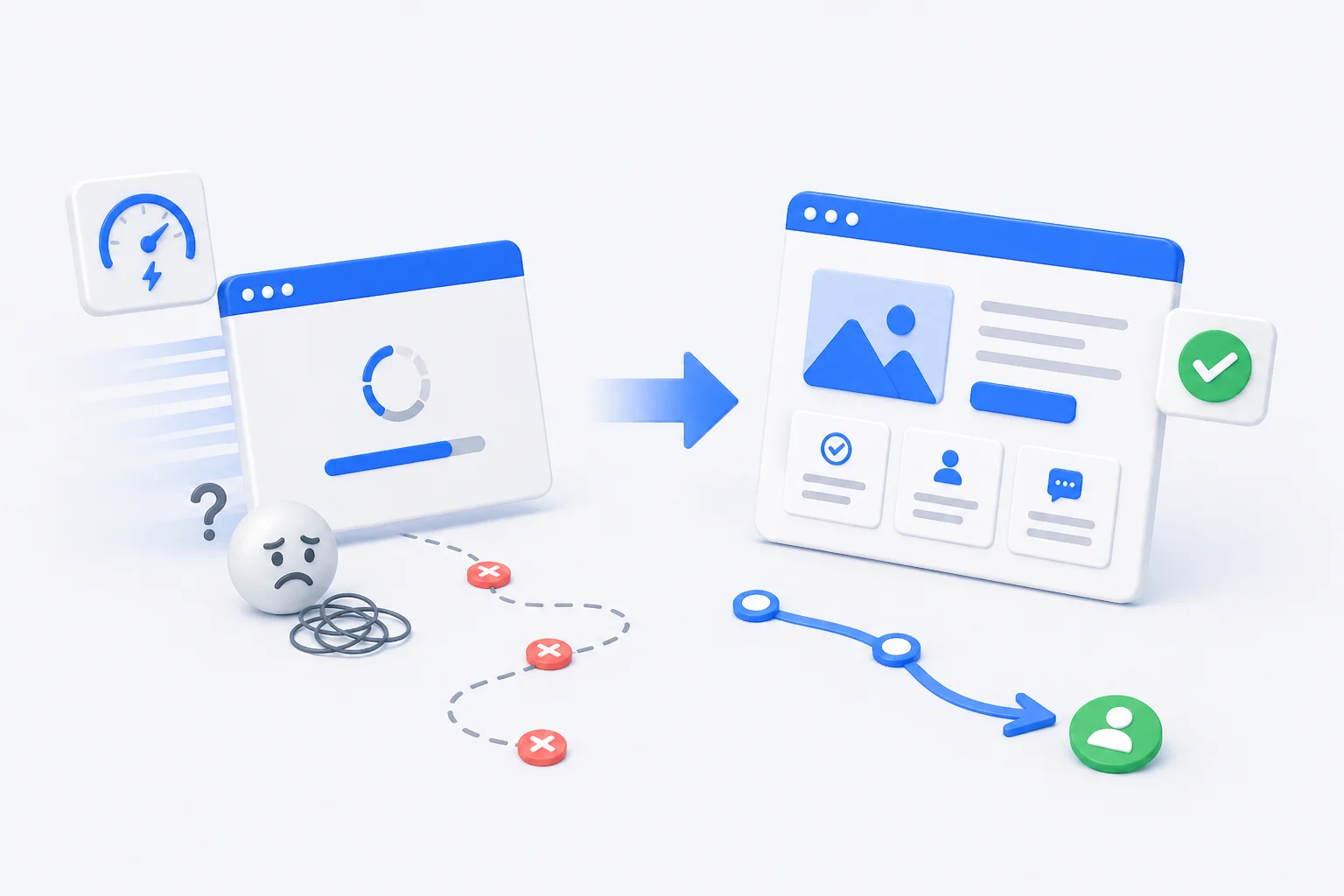
Page speed helps, but conversion comes from flow. See how structure, intent match, and UX clarity improve results.